RB · Sole Systems
Rubber outsoles, moulded to your drawing.
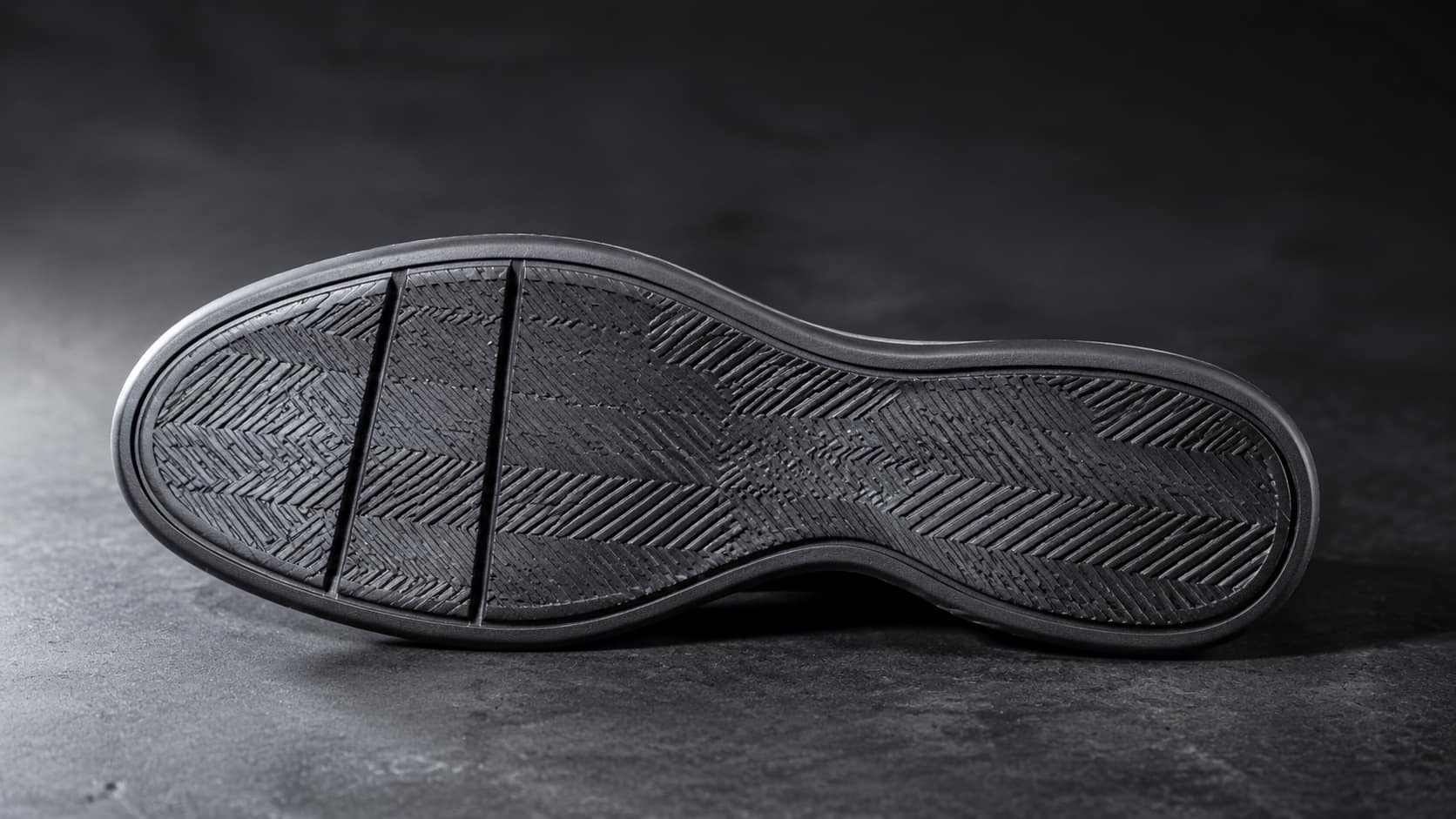
Compression-moulded vulcanised rubber: the heaviest of the sole families and the one that still outlasts everything else on abrasion and wet grip.
What it is
A vulcanised rubber outsole is the reference point every other sole material is measured against. The compound is mixed, pre-formed and compression-moulded under heat and pressure until the rubber cures. That is a slower cycle than injection, and the reason the finished outsole holds its edge definition and wear life.
Tread geometry comes from your drawing, your sample or our library. Compound is tuned to the shoe: harder and denser for abrasion, softer where grip and flex matter more.
Specification envelope
Where a row is marked held in production it is our own window, measured on the compounds we run. The rest describes the family. Values for your specific compound and construction come with the full spec sheet; request it below.
| Hardness | Held in production: 60–65 Shore A casual and lifestyle, 65–70 Shore A safety and work |
|---|---|
| Density | Held in production: 1.15 g/cm³ |
| Abrasion | Best wear life of the sole families |
| Colour | Black standard; Pantone matching and non-marking compounds on request |
| Structure | Solid or lugged tread; cemented, stitched or welted attachment |
Tested against
The standards buyers most often write into the specification for this family. In-house rigs run on site; items marked external are booked with an accredited laboratory. Full rig-to-standard mapping is on the quality page.
Where this sole is specified
| Segment | What drives the spec | Tests that gate it |
|---|---|---|
| Outdoor & Hiking | Deep lug geometry, wet rock grip, cold flexibility | Footwear slip SATRA TM144 · abrasion ISO 4649 · low-temperature flex |
| Work & Safety | Slip, heat and fuel-oil exposure; long wear life on hard floors | EN ISO 20345:2022 (slip now mandatory, SR marks the enhanced test) · HRO · FO |
| Court & Indoor | Grip without transferring pigment to the floor | Non-marking / scuff (SATRA TM223) · abrasion |
Hardness and density
These are windows Hongsole holds in production, not the range the material category can reach. Rubber and TPR are quoted in Shore A, EVA in Shore C. A spec sheet that mixes the two scales is worth a second look. Why the two do not convert.
| Application | Hardness | Density |
|---|---|---|
| Rubber outsole, casual / lifestyle | 60–65 Shore A | 1.15 g/cm³ |
| Rubber outsole, safety / work | 65–70 Shore A | 1.15 g/cm³ |
Steel, cut per size in our own mould shop. Rubber cures under heat and pressure for far longer than a thermoplastic cycle, and steel is what holds edge definition through it. Because tooling is cut per size rather than per style, the size run drives the mould count and therefore most of the tooling invoice.
How this sole fails, and what sees it coming
Every construction has characteristic failures. A supplier who names them is more use than one who implies there are none, and each of these is caught by a rig on the quality page rather than by an apology afterwards. Acceptance limits are yours to set; what follows is what to look for and when it is cheapest to look.
Waxes and curing agents migrate to the surface of a cured rubber outsole and leave a pale haze, worst on black and on saturated colours. It is a compound and cure question rather than a moulding fault, which is why the rheometer curve matters before the first press cycle, not after a container has landed.
A compound pushed hard for abrasion resistance loses elongation, and the loss shows first where the sole is asked to bend rather than where it is asked to wear. This is why the tensile figure is read as a pair, strength with elongation at break, on ISO 37 — one number alone hides it.
Vulcanised rubber is the heaviest of the six families. An outsole can clear every abrasion and slip requirement in the specification and still be rejected by the brand on finished-shoe weight, which is a decision to take at density on the drawing rather than after tooling is cut.
When to specify something else
Foamed rubber keeps the wear behaviour at roughly a third of the density →
TPR injects in a fraction of a cure cycle and holds Pantone across a run →
A rubber outsole over an EVA midsole puts each material where it works →
Our own figures, not a category benchmark. Held across the six sole systems; a programme that moves them says so in the quotation. Full terms, tooling cost and mould ownership are on the OEM & ODM page.
The other five systems
Foamed rubber that keeps the wear characteristics of solid rubber while cutting unit weight for all-day comfort.
Thermoplastic rubber soles with fast tooling turnaround and clean colour reproduction. Regrind-friendly process.
Rubber outsole bonded to an EVA midsole: abrasion where the ground is, cushioning where the foot is. Two densities, one part.
The combination sole moulded as a single unit. No bond line to delaminate, fewer assembly steps downstream.
Injection-moulded phylon for tight dimensional tolerance and repeatable output at volume. Dedicated IP tooling in-house.
Weighing one material against another? EVA, rubber and TPR compared runs the properties side by side.
Questions buyers ask about this
What hardness do you hold on rubber outsoles?
60–65 Shore A on casual and lifestyle outsoles, and 65–70 Shore A on safety and work outsoles, both at around 1.15 g/cm³. Rubber is always quoted in Shore A; a rubber outsole quoted in Shore C has been specified by someone reading the wrong scale.
Why is rubber tooling cut in steel rather than aluminium?
Rubber cures under heat and pressure for far longer than a thermoplastic cycle, and steel holds edge definition through that where aluminium would not. It is also why rubber tooling costs more than EVA tooling and why the tread on a vulcanised outsole stays sharp over a long production run.
Can you make a non-marking rubber outsole for indoor courts?
Yes. Non-marking compounds are formulated in-house and checked on our scuff-mark rig, referenced to SATRA TM223. Tell us the floor type: a compound that passes on a sealed hardwood court is not automatically the right one for a coated industrial floor.
Need the rubber outsoles spec sheet?
Send the drawing, the sample or just the shoe it has to survive. We come back with compound, hardness range, MOQ and timing for your programme.