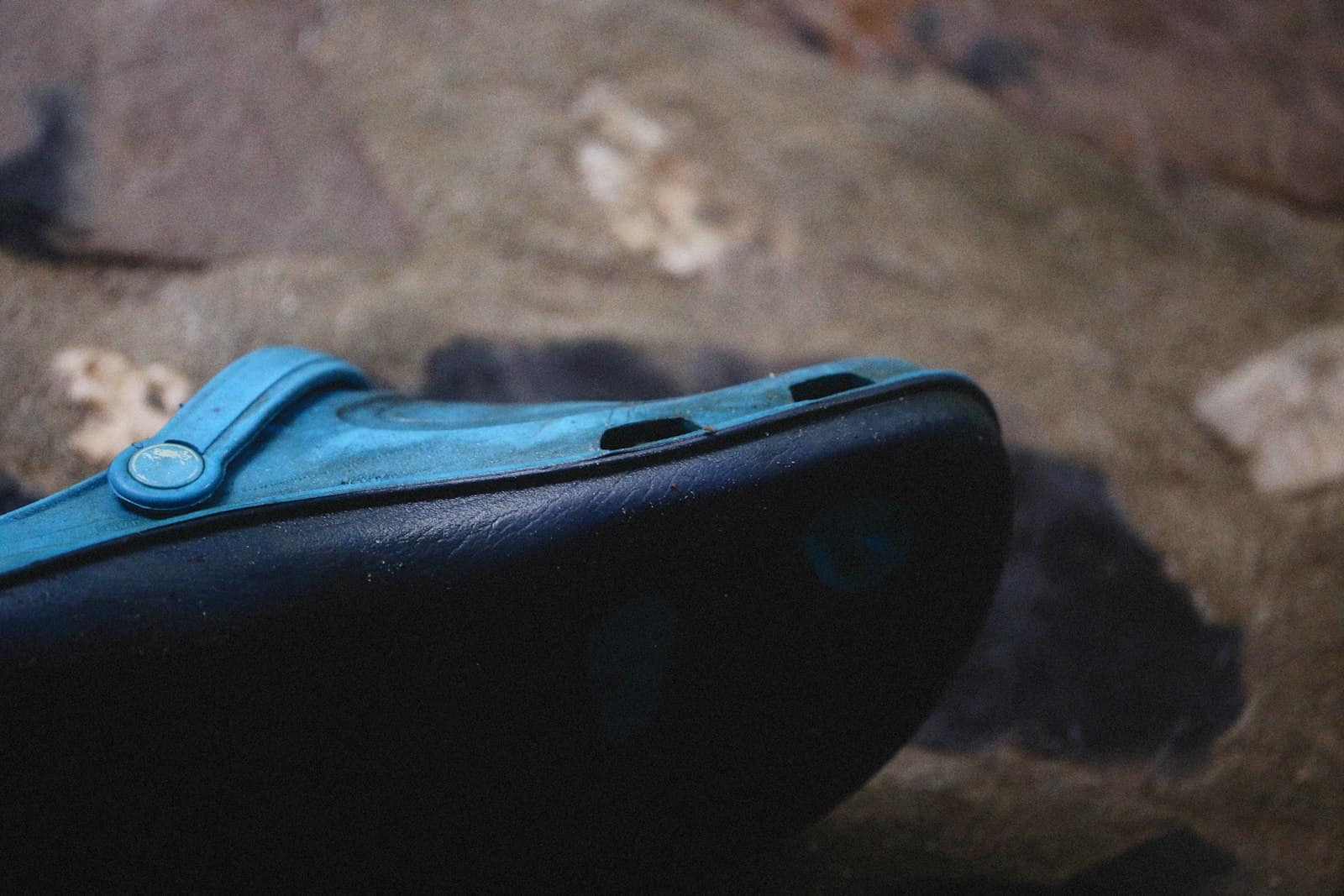
RB-F · Sole Systems
Rubber wear, without the rubber weight.
Foamed rubber keeps the ground feel and wear characteristics of a solid rubber outsole while cutting unit weight: the comfort-family answer to all-day casual shoes.
What it is
Foamed rubber starts from the same family of compounds as a solid outsole, expanded during the cure so the moulded part carries a closed-cell structure through its wall. The ground still meets rubber; the shoe just stops noticing the weight.
The trade is dimensional stability: a foamed part moves slightly more than solid rubber, which we allow for at the mould design stage rather than after production.
Specification envelope
Where a row is marked held in production it is our own window, measured on the compounds we run. The rest describes the family. Values for your specific compound and construction come with the full spec sheet; request it below.
| Hardness | Held in production: 60–65 Shore A |
|---|---|
| Density | Held in production: 0.40 g/cm³, roughly a third of solid rubber |
| Abrasion | Good, between solid rubber and TPR |
| Colour | Full Pantone range; colour runs through the wall, not a surface coat |
Tested against
The standards buyers most often write into the specification for this family. In-house rigs run on site; items marked external are booked with an accredited laboratory. Full rig-to-standard mapping is on the quality page.
Where this sole is specified
| Segment | What drives the spec | Tests that gate it |
|---|---|---|
| Casual & Lifestyle | Weight, colour fidelity and unit cost at seasonal volumes | Colour hold · shrinkage & yellowing · abrasion |
Hardness and density
These are windows Hongsole holds in production, not the range the material category can reach. Rubber and TPR are quoted in Shore A, EVA in Shore C. A spec sheet that mixes the two scales is worth a second look. Why the two do not convert.
| Application | Hardness | Density |
|---|---|---|
| Foamed rubber outsole | 60–65 Shore A | 0.40 g/cm³ |
Steel, as for solid rubber, with the expansion allowed for at mould design rather than corrected afterwards. A foamed part moves slightly more than a solid one as it leaves the tool, so the shrinkage allowance is set before anything is cut, which is why the mould shop and the compounding sit on the same site.
How this sole fails, and what sees it coming
Every construction has characteristic failures. A supplier who names them is more use than one who implies there are none, and each of these is caught by a rig on the quality page rather than by an apology afterwards. Acceptance limits are yours to set; what follows is what to look for and when it is cheapest to look.
Cell structure is the whole product here, and it is the property most sensitive to mix and cure. A drifting batch shows up as a change in grams per cubic centimetre on ISO 2781 before it is detectable by hand as a change in hardness, which is why density is the check that gates a repeat order rather than the durometer.
A foamed sole that starts at the signed-off height can settle under repeated loading and lose part of it. This is a service-life property rather than a day-one measurement, so it is caught by conditioning specimens in the chamber and re-testing, not by any single reading taken at sign-off.
Foaming trades tensile strength for weight, so a wall or sipe that would be safe in solid rubber can tear. It is a drawing problem more often than a compound problem: the fix is section thickness agreed at DFM review, before a mould exists to argue with.
When to specify something else
Our own figures, not a category benchmark. Held across the six sole systems; a programme that moves them says so in the quotation. Full terms, tooling cost and mould ownership are on the OEM & ODM page.
The other five systems
Compression-moulded rubber outsoles built for abrasion resistance and grip. Custom tread geometry from your drawing or sample.
Thermoplastic rubber soles with fast tooling turnaround and clean colour reproduction. Regrind-friendly process.
Rubber outsole bonded to an EVA midsole: abrasion where the ground is, cushioning where the foot is. Two densities, one part.
The combination sole moulded as a single unit. No bond line to delaminate, fewer assembly steps downstream.
Injection-moulded phylon for tight dimensional tolerance and repeatable output at volume. Dedicated IP tooling in-house.
Weighing one material against another? EVA, rubber and TPR compared runs the properties side by side.
Questions buyers ask about this
How much lighter is a foamed rubber sole than a solid one?
We hold foamed rubber at around 0.40 g/cm³ against 1.15 g/cm³ for solid rubber, roughly a third of the density for the same moulded volume. Hardness stays in the same window, 60–65 Shore A, so the sole feels similar underfoot rather than soft.
Does a foamed sole wear as well as solid rubber?
Not quite. Abrasion sits between solid rubber and TPR: good, but solid vulcanised rubber remains the best wear life of the six families. Foamed rubber is the right answer when unit weight matters more than the last increment of abrasion life.
Is a foamed rubber sole dimensionally stable enough for a graded size run?
Yes, provided the expansion is allowed for at mould design rather than corrected afterwards. A foamed part moves slightly more than a solid one as it leaves the tool, so the shrinkage allowance is set before anything is cut, which is one reason the mould shop and the compounding sit on the same site.
Need the foamed rubber soles spec sheet?
Send the drawing, the sample or just the shoe it has to survive. We come back with compound, hardness range, MOQ and timing for your programme.